

A Walk into Julia Morgan's Masterpiece: The Chapel of the Chimes

Our Piedmont Recreation Department’s Walking on Wednesdays group had a good turnout of 42 walkers last Wednesday for another special walk and tour.
Walking on Wednesdays makes semi-annual visits to the Mountain View Cemetery but we had never gone to and toured the nearby Chapel of the Chimes Columbarium and Mausoleum. It is open to and welcomes the public. It was an overcast morning and a great day for a good walk and a first-time visit. Walkers who preferred not to make the little over a mile walk from the Exedra to the Chapel drove and met the others there.
We headed off going down Highland and Moraga Avenues. Along most of the north side of Moraga is the high, cement wall of the Mountain View Cemetery. Just past Monticello Avenue, on the other side of the wall, is a statue of an elk on a cemetery monument that looms above Moraga. It marks a section of the cemetery for long deceased members of the lodge.
We crossed Moraga at Ramona Avenue and went down the one-way portion of the street. This quiet roadway is lined with bungalow style homes that were built in the 1910s, and whose backyards border the cemetery. One home has a particularly wonderful succulent, front yard garden. We arrived at the chapel a little before 11:15 so there was ample time to find the car-driving walkers and talk about the chapel’s history.
In 1902 a small group of civic-minded Oakland undertakers led by William A. Wishart founded the California Electric Crematory and California Memorial Columbarium at the present site, which had been a trolley station. Some walkers remembered that Walter Blair, Piedmont’s first European settler, was involved in trolly lines and partnered with other investors to build The Broadway & Piedmont Horsecar Line that opened in 1876. This horsedrawn rail line ran from downtown Oakland up Broadway to Piedmont Avenue and the Mountain View Cemetery.
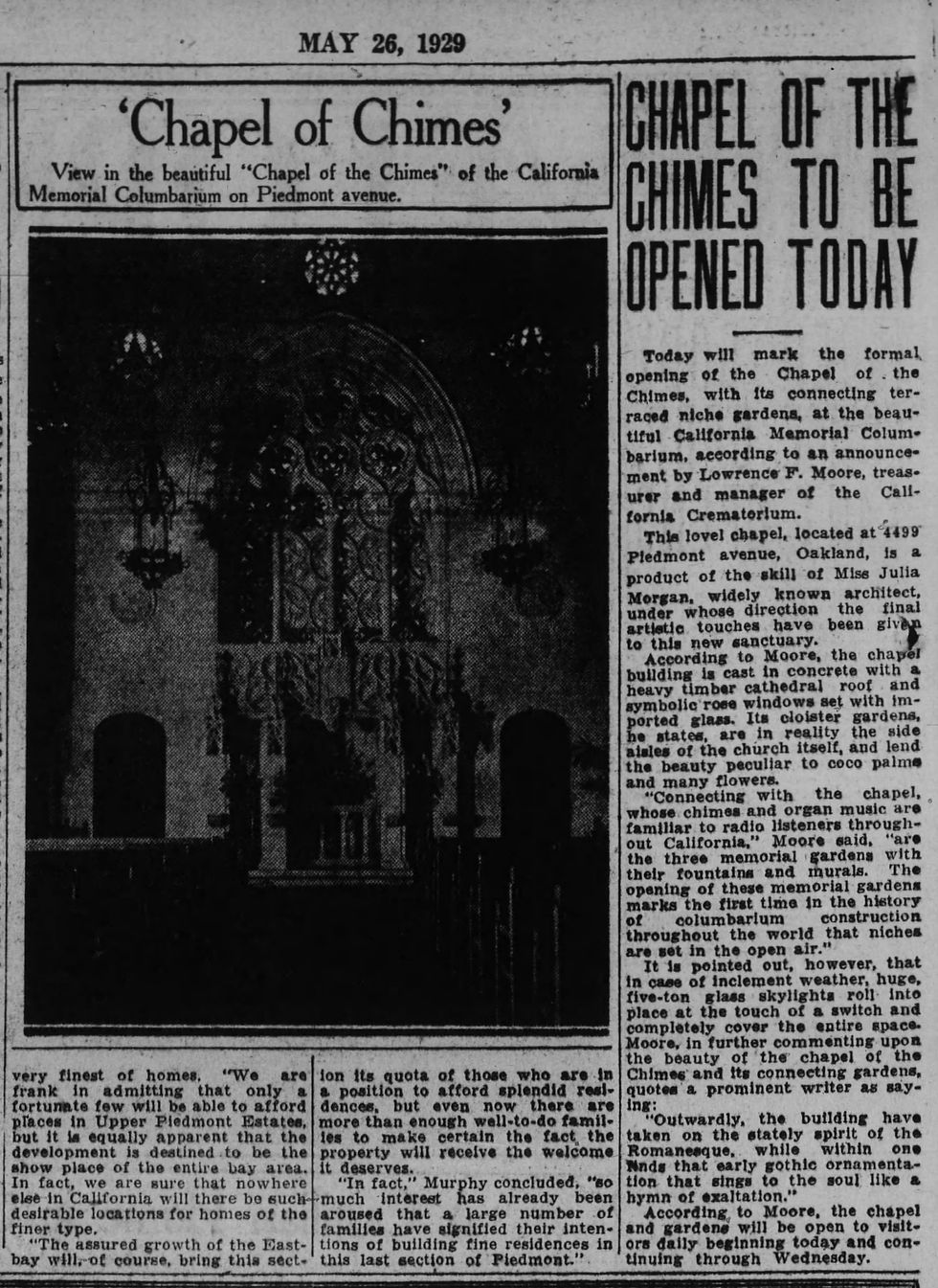

The historic columbarium has been continuously operated as an “indoor cemetery” since 1909. In 1911, Lawrence E. Moore, a young casket salesman was hired to direct the columbarium. Under his guidance, it grew into one of the largest columbariums in the world. Moore was also responsible for building an extension. This addition was named in honor of Frances Willard who was an early leader of women’s rights and was also the first woman to publicly endorse cremation.
In 1926 Julia Morgan, the legendary architect who designed Hearst Castle, was commissioned to continue renovations and design new additions. The Chapel of the Chimes was dedicated on Memorial Day in 1928. Morgan continued as advisor, both for architectural additions and decor. She transformed the space into a labyrinth of chapels, gardens, cloisters, atriums, alcoves, and three terraced indoor gardens. Her design has Moorish, Romanesque, and Gothic architectural elements and is complemented with European art.
More than a half-acre of glass was used in the construction. Reinforced ribbed wire glass formed the greater part of seven glass roofs above the chapel’s gardens. The roofs could be rolled away with the press of an electronic button to open the gardens to the sky. Named for the chimes in its tower, the three-story Chapel of the Chimes was officially opened on May 26, 1929.
The facility passed through several corporate owners during the consolidation of the funeral industry in the late 20th century. Today it is owned and operated by Chapel of the Chimes Oakland, which is part of a funeral and cemetery network operated by Dignity Memorial. This is the consumer brand of Service Corporation International (SCI), the largest funeral and cemetery company in North America. The Chapel of the Chimes is adjacent to and often associated with Mountain View Cemetery, but they are separate entities with different ownership. The exact number of human remains interred at the columbarium is not publicly reported, but it is estimated to be very large, possibly over 50,000.
The Chapel of the Chimes provides a self-guided tour brochure, but we realized we would want to tour at different paces so the plan was for everyone to take their time and return to the Exedra individually. Understandably, K-9 best friends are not allowed in the chapel. There was a service being conducted with family members in attendance and we were mindful of respecting their privacy.
We went into the chapel through its main entrance and splintered off down the maze of different corridors to see rooms lined with thousands of niches containing urns. Throughout the columbarium are walls that that resemble bookshelves packed with urns that resemble books behind locked, clear windows. The urns’ book-like back covers have names and dates of birth and death that provide the most basic summaries of the people’s life stories.
The Chimes Chapel is the main chapel. It was designed by Morgan in 1926 with Gothic details accentuated by hand-hewn wood beams. This chapel’s centerpiece is a Wurlitzer 20-rank pipe organ. It became famous in the 1920s as it was played on religious radio broadcasts heard over much of the western United States.
Other tour highlights were a magnificent Lapis Lazuli Fleur de Lis inlaid table brought from Europe by Morgan for the chapel. The Bible Cloister has an impressive exhibit of heirloom Bibles and prayer books. There is also a glass-enclosed page from an original Gutenberg Bible printed in 1453.
Morgan incorporated many symbols that include the Trinity, the quatrefoil, the Star of David, and the Star of the Nativity into a Romanesque and Gothic Meditation Chapel and its adjoining gardens. Another European treasure is a Byzantine Processional Cross dating back to 1640. Morgan also brought light into the rooms with the rolling skylights and Belgian stained glass windows.
The Garden of Revelation is the largest garden within the Chapel of the Chimes. It features niches within the planters along with full size crypts, and individually lit glass niches. There is a large fountain surrounded by benches, which also hold cremated remains.
As walkers left the columbarium and made their way left toward the Sanctuary, they noted a downward staircase. It was originally built for the Hearst Castle, but Morgan requisitioned it for the Chapel of the Chimes. Taking the elevator to the third floor, some walkers found the crypts of Oakland Raiders owner Al Davis and legendary blues artist John Lee Hooker.
We took our time enjoying the different forms of beauty that the chapel offers and made our return to the Piedmont city center individually retracing our steps back up Moraga and Highland. It was our first visit to the Chapel of the Chimes, but with so much to see, it will not be our last.


Comments