

Requa, Ransom, and Remarkable Women
Updated: Mar 30


It was a sunny, warm, summer-like morning last Wednesday when our Piedmont Recreation Department’s Walking on Wednesdays group came together at the Exedra for our weekly walk. The weather was one thing to celebrate but there was something else. Women's History Month is celebrated throughout the entire month of March. It spotlights the contributions of women to our history, culture, and society, and was officially established in the U.S. by Congress in 1987.
There was a large turnout of 51 walkers and four K-9 best friends on hand.
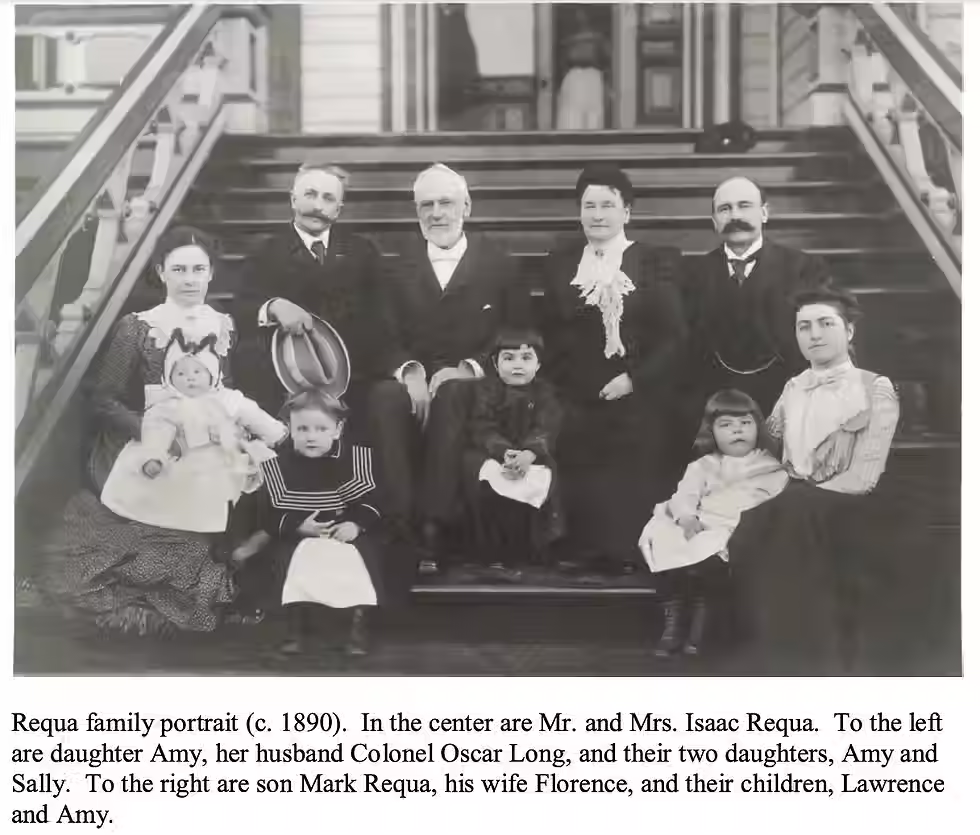
Two of the more prominent women in early Piedmont history were Sarah Requa, the wife of Isaac Requa, and their daughter, Amy Requa Long. On past walks we had talked about Amy establishing the Ransom Bridges School, the first school in Piedmont, in 1913, but we hadn’t spoken much about “The Highlands” estate that the Requas created.
Meghan Bennett’s History of Piedmont website has a page, https://www.historyofpiedmont.com/requa, with information and pictures of the Requa family. It was shared that in 1850 Isaac sailed by clipper ship around Cape Horn to San Francisco from New York. He made his fortune during the second half of the 19th Century in Nevada silver mining and with the Central Pacific Railroad and the Oakland Bank of Savings.
Sarah Mower Requa was born in Bangor, Maine in 1829. After Sarah’s father died of tuberculosis in the early 1850s her mother and her three sisters also sailed to California around Cape Horn to San Francisco. At the time its harbor was filled with vessels from all over the world and the city was just a village of huts and tents.
Sarah later went to the Gold City mining district in the Nevada Territory. She developed such cooking skills that when she left Gold Hill she had made $14,000, a very significant amount at the time. Many wealthy miners bid as much as $50 a plate to eat at her table. At Gold Hill she met Isaac, whose home was near hers. They were married in 1863 in San Francisco and then returned to Gold City.
It has been said that silver from the Nevada Comstock Lode built San Francisco. Requa’s Comstock wealth certainly built one of the finest mansions in what was to become Piedmont. In 1877 the Requas bought about 80 rolling, unimproved acres in the foothills of Oakland as a site for the mansion where they lived for the rest of their lives. In the 1880s there were only seven houses where Piedmont is now and the Requas’ was the biggest. They called their home "The Highlands."
The estate was centered around a great fame mansion on a commanding knoll where the present Hazel Lane and Requa Road meet. It encompassed land that extended across what are now Hazel Lane, Requa Road, Windsor Avenue, Wildwood Avenue, and overlooked Lake Merritt, the Bay, and the San Francisco Peninsula. This is also the historic spot where it is said the Spanish adventurer, Gaspar de Portola, camped with his Spanish exploration party in 1772.
The mansion's yellow with brown like trim color scheme gave it a beacon-like quality and, because there were no trees on the hills, sailors could see the house from San Francisco Bay. This towered, gabled mansion had 22 bedrooms and a dining room table that could seat 24. There was also an adjoining wing was solely for the domestic help. In addition, 11 hired hands had other quarters on the estate.
Since it was a long trip in horse-drawn vehicles to Oakland by way of Vernal Avenue, Moraga Road, and Piedmont Avenue, the manor was all but self-sufficient. It had its own vegetable gardens, orchard, berry patches, a dairy herd of 11 cows, a stable with seven stalls and a grooming room, an illuminating gas manufacturing plant, and an independent water supply from the wells on the property. The grounds were landscaped with hundreds of trees, pines, palms, gingkoes, eucalyptus, and ornamentals of different types. There was a fountain, croquet court, and a wooden fence and gateway along today’s Highland Avenue. Walter Blair’s originally named “Vernal Avenue” was renamed Highland Avenue in 1910 to honor the mansion.
Isaac died in 1905 and following the death of Sarah in 1922, at the age of 93, The Highlands mansion was torn down in 1923. After the death in 1928 of Amy’s first husband, Brigadier General Oscar Fitzalan Long, Amy subdivided The Highlands into a residential subdivision of 42 houses.
Before all of this development, what was originally The Highland’s architect's office during the mansion’s construction came to be a schoolhouse for the Requa children, Amy and Mark. At the turn of the 20th Century, Amy wanted her two daughters to have good educations, so she got her father to build a one-room schoolhouse on the estate. Amy hired a teacher for her daughters and a few neighborhood children. This was the first school in Piedmont. Interest in the school grew and in 1905 Amy leased a house at the corner of Highland and Hazel Lane for it. She also hired Marion Ransom and Edith Bridges from the Anna Head School in Berkeley to be the new school’s teachers.
The school attracted the daughters of prominent Piedmont and California families and soon outgrew its space. In 1908 Amy hired noted architect Julia Morgan to design a new school building with classroom and dormitory rooms on five acres of land that is now Hazel Lane. The new Miss Ransom and Miss Bridges School for Girls opened in 1913. Soon after additional classrooms and a gymnasium were added. The school had dormitory rooms for up to 70 students from first grade through high school. In 1924 there were 186 students and in 1928 there were 21 teachers and 42 graduating seniors.
However, the stock market crashed in 1929 and the Depression that followed created financial difficulties for many Ransom Bridges School parents. The new Piedmont High, which started in 1921, was less expensive and Ransom Bridges’ enrollment declined dramatically. In 1932 there were only 12 graduating seniors, and it closed in June that year.
In 1936 the Ransom Bridges’ school building was demolished and the land was developed as Ransom Gardens with Albert Farr as its architect. The neighborhood’s first house at 152 Hazel Lane was built in 1937. Amy died in 1960, at the age of 83 in her home at 9 Requa Place. At the time of her death, she was known as Amy Requa Mitten, having remarried Homer Mitten in 1941. She is buried at Mountain View Cemetery.
We started out going down Highland Avenue to its corner with Hazel Lane for some school history and then continued up the street. It is thought that Hazel Lane gets its name from the hazelnut trees (i.e., “hazels”) that were prominent on the lush, wooded grounds of the original Requa estate and later the school campus. We made our way through the Hazel Lane loop to the school’s former site at 141 Hazel Lane. Architect Jim Kellogg pointed out lovely details on this home’s Albert Farr craftsman design exterior.
We completed the loop back to Requa Road and went up the Requa Place cul-de-sac to see the view that The Highlands mansion and the Requas once enjoyed. We stopped between the two red brick pillars that one marked The Highlands’ entrance for a group photo and went up to 9 Requa Place where Amy Requa Mitten lived and died. We looked over to our right and could see Piedmont High School, which is surprisingly close by.
Then we went back to Requa Road and walked down it to Wildwood and Winsor Avenues where The Highlands’ lower boundary once was. At the steps on Wildwood that lead down to Witter Field we noted a set of Eastern redbuds that are a Piedmont Heritage Tree and were in bloom. This is a large deciduous shrub or small tree that is native to eastern North America from southern Michigan south to central Mexico, west to New Mexico. Species thrive as far west as California and as far north as southern Ontario. It is also the state tree of Oklahoma.
We continued on and made our return to the Exedra was via Winsor and Park View and Magnolia Avenues with a greater appreciation of Sarah and Amy Requa and other women, like Marion Ransom, Edith Bridges, Julia Morgan, who were important in Piedmont’s early history and development.
After completing our walk, about 30 of us met inside the Community Hall for a discussion about how Walking on Wednesdays might be restructured so that it will continue long into the future. It was decided that more walkers will take roles in leading different aspects of the activity. An initial step will be to conduct a talents and interests survey to understand what group members are interested in doing.


Comments