

The Story Beneath the Turf: Hampton Park’s Forgotten School Site

Last Wednesday was the first Wednesday of fall and a milder day than earlier in the week, and our Piedmont Recreation Department’s Walking on Wednesdays group was up for a long walk to streets further from the center of town. We hadn’t been to the Marlborough Court this year and climbing up Hampton Road to see it was the plan. But plans but sometimes change.
There was a good turnout of 44 walkers and four K-9 best friends at the Exedra for the hike.
We headed off, going up Highland Avenue to Wildwood Avenue. We walked up Wildwood to enjoy the color of the maple tree leaves on both sides of the street. They had turned burgundy and provide the closest thing Piedmont has to New England fall colors. Our long line of walkers then went through the Hall Fenway to Crocker Avenue and Hampton Road, and we reassembled in front of the entrance to Hampton Park.
It was remembered that we had abbreviated a July walk through the park because it was closed for a Recreation Department summer kids camp. The park was now open and available for us to take a look. So, we modified our plans and made our way around the baseball field’s warning track to the park’s back. Along the way we noted the mulberry trees in front of the Piedmont Play School that were our 2023 winning entry in the Piedmont Park Commission and Parks Department’s "Heritage Tree” competition.
The site of Hampton Park has evolved greatly over the years. It is much different today than 100+, 50, and even 25 years ago. From Piedmont Historical Society it was shared that Hampton Park was once part of 50 acres purchased in 1911 by Louis Titus, a Berkeley real estate developer. He intended to build a mansion on this large tract of land, but in 1912 the new city of Piedmont raised property taxes significantly. Titus dropped his plans and left Piedmont.
In 1914 James Tyson, a lumber and shipping businessman bought 30 acres of the land for his home. Tyson was a strong supporter of Piedmont Boy Scouts, which began in 1910, and in 1921 he made a portion of his land available to the Piedmont Scouts for their use as an outdoor camp. During the Great Depression in 1938 Tyson also make this land available to the Piedmont schools. A WPA project leveled it with the intention that it would be the site of a future “East Piedmont” school.
An article from Meghan Bennett’s History of Piedmont website, historyofpiedmont.com, contains an Oakland Tribune December 18, 1956 article that reported, “The Board of Education today prepared an option agreement under which it may buy two lots adjoining a proposed new elementary school site at Hampton Road and LaSalle Ave. … The proposed school site would be on the property already owned by the Board of Education, but construction is being held up pending repairs to the Tyson Lake Dam, now considered unsafe, located directly above the land.” This fourth Piedmont elementary school was never built. In the 1950s and 60s the land was a dusty, sometimes muddy little league baseball field. Years later, after grass was planted, youth soccer matches were often played on a soggy field because the underground water flow that feeds Tyson Lake was an on-going problem.
The Play School building was constructed in 2000 to house its and Recreation Department programs. More dramatic improvements were made during 2017 in a $2 million public/private partnership that the Piedmont community generously supported. Drainage and artificial turf were installed that made the field more serviceable during the year.
In 2019 the baseball backstop was dedicated and named in honor of Oakland Police Officer John Raymond Hege. The 41-year-old Piedmont native was one of four officers fatally shot following a traffic stop in East Oakland on March 21, 2009. He was the only one who remained alive long enough to enable his organs to be donated to people in need of transplants.
The field is used today for organized baseball, children¹s football, and soccer. The park also has two tennis courts, a backboard, a volleyball court, and six basketball hoops. There is a children's play structure and sand area that are conveniently located a few feet from the tennis courts.
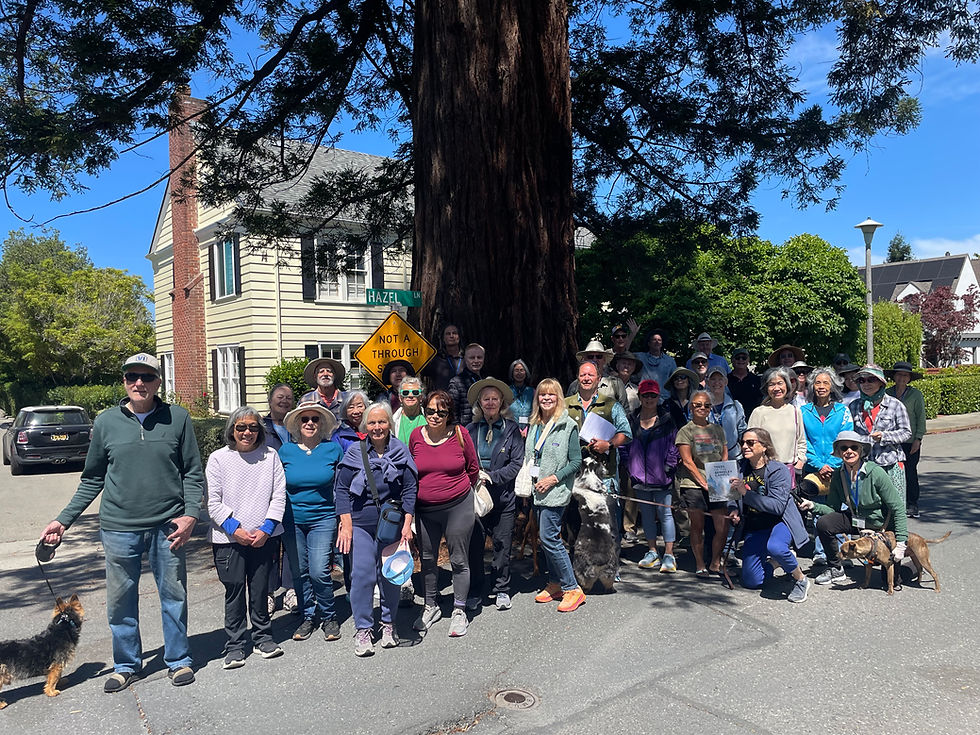
We checked out the Guy Saperstein Basketball Court with Tyson Lake hidden above it up the hill and took the attached group photo. We then made our way behind the play school, where little people were having fun in its back yard, and emerged on upper La Salle Avenue after climbing a steep set of stairs.
We went down La Salle to Indian Road and went up it. Near where Indian meets Hampton, we noted a community roadway that serves four Indian Avenue homes tucked up the hill off the street. We had never walked it, and curiosity called us up it. The road is lined with trees, flowers, and other vegetation leading up to the attractive, secluded homes.
We retraced our steps back to the main Indian Road and then to Hampton, Crocker, Wildwood, Sheridan, Highland, and the Exedra. The walk turned out to be different than what had been planned, but it was good. We know fun surprises are often part of Walking on Wednesday’s mornings.
P.S. I’m also attaching a fun 1929 map of the land that became Hampton Park. It’s from Meghan Bennett’s History of Piedmont website.


Comments