

Eight Years, 52 Walkers, and One Historic Cemetery Tour
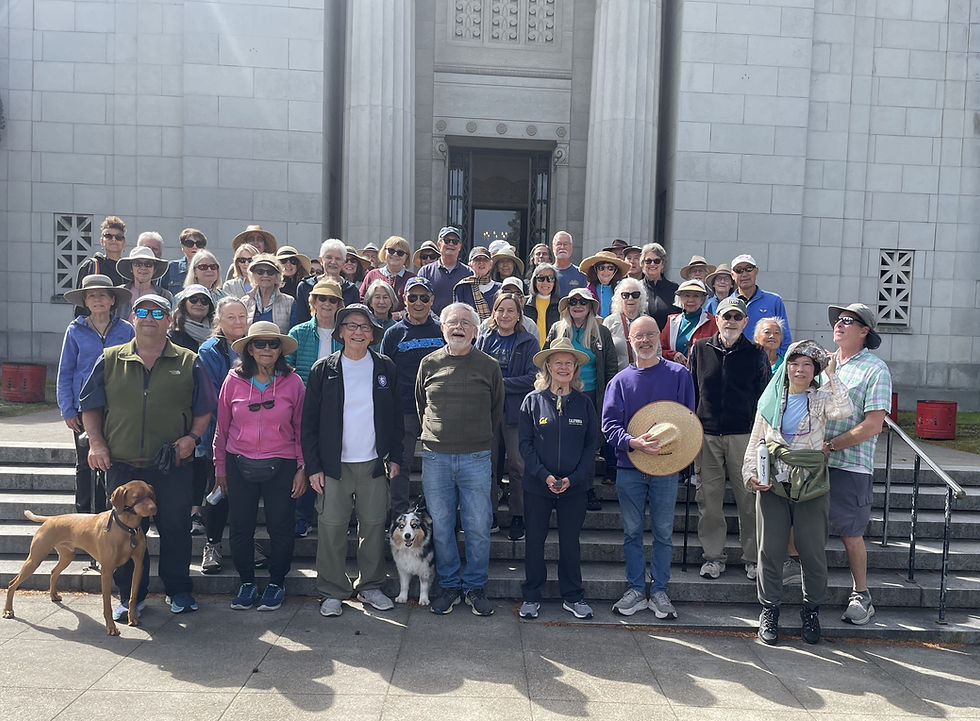
Last Wednesday was the 8th anniversary of our Piedmont Recreation Department’s Walking on Wednesdays group walking together. There was a big turnout of 52 walkers and two K-9 best friends at the Mountain View Cemetery to celebrate with a special walk.

We met in front of the cemetery’s main mausoleum for a tour conducted by author, newspaper man, and historian Dennis Evanosky. He has literally written the book on the cemetery, actually two books on it, as well as books about Alameda and Oakland’s Laurel District. His knowledge of the Mountain View Cemetery is encyclopedic. This was the fourth year Dennis had generously shared his knowledge of the cemetery with us.
During introductions and announcements, Charlene Louie and Sandra Cook were recognized as being walkers who were on our first walk on April 18,2018.
Dennis got started by taking us across the roadway. He said we were in front of the “main mausoleum” that was built in 1928 in a neo-classical design, but there is another, earlier “main mausoleum” across the way. It was named after Charles Main, a 49er who made his fortune building the parts necessary for riding horses. Main Street in San Francisco is also named after him. When the cemetery administrators built the second mausoleum they didn’t bother to rename either, so there are two “main mausoleums” at Mountain View.
Dennis also pointed out his “three girlfriends” right above us in mausoleum’s façade. They are statues of ancient Greek women that represent how well and long life is lived. Dennis noted the last one is holding a scissors. Five buildings were added to this central section of the cemetery through 1933, but the cemetery’s history goes much further back.

The Mountain View Cemetery was established in 1863 by city leaders. They asked Fredrick Law Olmsted to design their cemetery and final resting place. Olmsted had planned New York's Central Park, as well as much of the Stanford University and UC Berkeley campuses. Olmsted was managing gold mines in Bear Valley, California at the time. He had 197 acres to work with, and 23 more were bought later, so the cemetery is a total of 220 acres. He was promised $2,500 for his work with $1,000 up front. However, it seems the cemetery didn’t pay him the full amount. Stanford and Cal may have stiffed him too because they didn’t like his designs. There were actually two Fredrick Olmsteds who designed the cemetery. “Fred” Olmsted created the original portion and his son, “Rick,” designed a second portion further up the hill in the 1940s.
This was to be a cemetery of plots and lots, and not a park. Dennis explained that there are different types of cemeteries. Some have large monuments and tombs, others have smaller headstones, and others have flat-to-the-ground burial markers, which make mowing the grass far easier. This happens every Tuesday and Wednesday at Mountain View. Dennis said people buy lots for graves, which are part of larger plots.
The cemetery is non-denominational. People of every race are buried at Mountain View. There is no prejudice. If you have the money, you can buy a grave site. St. Mary’s Catholic Cemetery was established in 1863, slightly before Mountain View, and is just north of the cemetery. It wasn’t until 1968 that the Catholic Church permitted its members to be buried at Mountain View. In 1864 people of the Jewish faith purchased two acres from Mountain View also on its northern side. Dennis said the name, Mountain View, is a popular one for cemeteries and there are hundreds with this name in the country.
Dennis led us up the roadway to the end of mausoleum, past its first addition, where it looks like a creek is coming out of the ground, but it is actually fountain. Not far way is the grave of architect Bernard Maybeck, whose Piedmont homes we have enjoyed on our walks.
Long ago, a creek, called Cemetery Creek (but Glen Echo Creek after the water leaves the cemetery), was dammed to create a small, “no name” lake. It provides water for the cemetery’s lawns and plants, as well as its resident turkeys, deer, fish, cats, other wildlife, and now eagles. In early times the lake’s water was also used to keep road dust down. The heavy algae on the lake is part of a natural cycle, and the ducks swimming on it didn’t seem to mind it.
Dennis took us up to the south side of the cemetery. He pointed out a hillside that he referred to as “Berkeley Row” because a number of prominent people from the University of California’s history are buried there. One is Francis Kittredge Shattuck who was a prominent civic leader in Berkeley’s early history and also the mayor of Oakland in 1859. Shattuck Avenue and Kittredge Street in Berkeley are named after him. Also nearby is the grave of William M. Gwin who with John C. Fremont were California's first two U.S. Senators in 1850, immediately after the state was admitted to the Union.
Dennis took us further up the hillside, near the cemetery’s Moraga Avenue border, to what was once an “unendowed” area. The price of unendowed grave sites did not include a payment for their perpetual care. Endowed graves did. The families of those in the unendowed graves were expected to maintain them. Over time this ceased to happen and the graves became overgrown with vegetation and unidentifiable. Dennis has been part of efforts to identify these graves and to open spaces for new graves. He estimated there are about 190,000 graves in the cemetery with room for about that many more.
A statue depiction of a cloth was also noted. It represents a pall that covers a casket. Depending on the deceased’s wealth, it could be buried with the person or just rented. And so, we have “pallbearers. Dennis also pointed out the many obelisks around the cemetery. They mark graves from the late 19th Century when the Washington Monument was built in 1882. Obelisks became very popular. Up the hill was a tall statue of an elk on a monument. This section of the cemetery was for Elks Club members.
As Dennis led us down the road, he pointed out an oak tree that is about 350 years old and a dawn redwood that was brought here from China in the early 1900s. The latter is deciduous and people sometimes think it is dying during the winter. Another interesting tree is a huge cedar that marked the entrance to the cemetery’s “Plot 1” in the 1860s. Dennis also said firefighters once told him that the cemetery’s mostly open space saved Piedmont from burning in the massive 1991 Oakland Hills firestorm.
Across the cemetery was one of the cemetery’s main attractions, “Millionaires’ Row.” It is a section where the most grand, elaborate crypts stand, housing some of the cemetery’s most famous and wealthy residents. These were very successful businessmen, just about all of whom came to California around 1850. They did not use picks and shovels during California’s gold rush to make their fortunes but rather sold the miners the things they needed.
It was also noted that there is the plot for the Grand Army of the Republic soldiers, which Dennis played instrumental role in restoring. They were Civil War Union veterans who died in California, or whose bodies were moved to Mountain View. There are also Buffalo Soldiers buried in the cemetery. They were all-Black U.S. Army regiments formed by Congress in 1866, following the Civil War, to serve during peacetime.
The morning flew by as Dennis shared his fun, historical information. Before we knew it, it was time for us to make our way back down the hill to our cars. We said goodbye to Dennis Evanosky until next year and expressed our thanks to him. We had enjoyed an information-packed tour of a beautiful place on a special day with a wonderful storyteller.


Comments