

Famous Families, Powerful Women, and the Making of Mountain View Cemetery

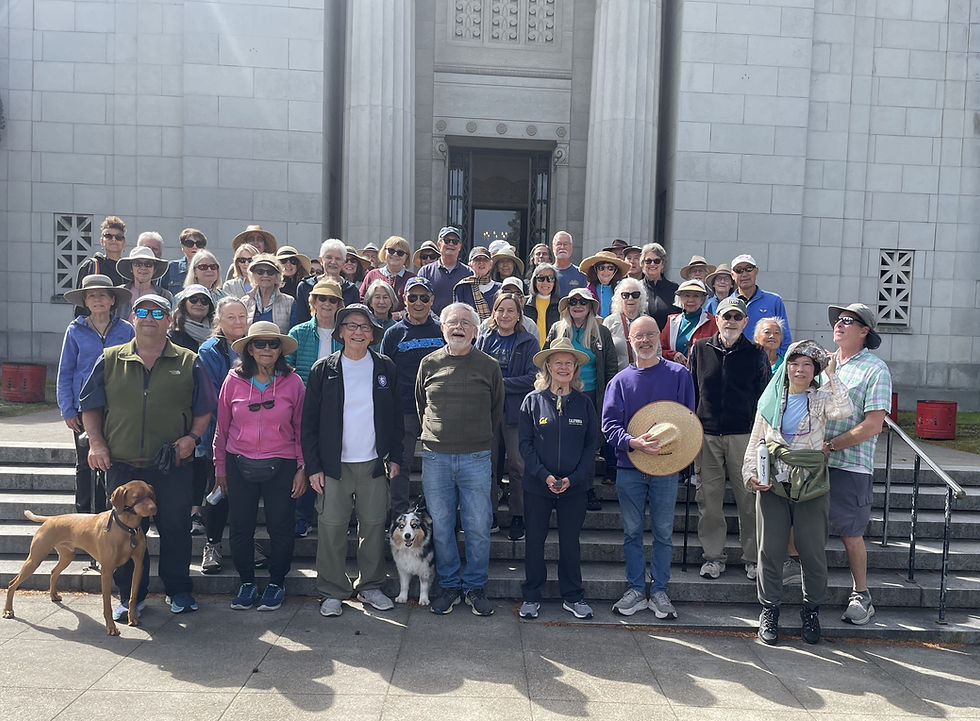
This past Wednesday, October 29th, was just two days before Halloween, and time for our Piedmont Recreation Department’s Walking on Wednesdays group’s annual pre-Halloween tour of the Mountain View Cemetery. Instead of meeting at the Exedra we assembled in front of the cemetery’s main mausoleum. There was a big turnout of 54 walkers and three K-9 best friends on hand.
This tour for us was conducted for the fifth time by long-time docent Jane Leroe. She is a retired, ground-breaking, San Francisco trial attorney who says she was a “feminist” before there were “feminists.” Jane has an extensive knowledge of the Mountain View Cemetery and loves to share it. Her tour for the day was “Famous Families” of the historic cemetery.
Jane started off with some cemetery history. In the early 1860s a group of twelve, leading, local businessman led by Samuel Merritt, a San Francisco physician and the 13th mayor of Oakland from 1867 to 1869, decided the area needed a better private cemetery. Two public cemeteries existed, but they were not well maintained, and the group wanted something better for their final resting places. They bought 200 acres of fields at a cost of $13,000, and the Mountain View Cemetery was established in 1863 and officially dedicated on May 25, 1865. It was Memorial Day that year. It was thought that certainly the cemetery would always be far from the center of Oakland. Twenty-six acres were added later, so the cemetery has a total of 226 acres. About one hundred and seventy thousand people are buried at Mountain View, and there is room for an additional 170,000.
The founders’ contract with Frederick Law Olmsted, the landscape architect who also designed New York City’s Central Park and Stanford University, call for him to get $1,000, but it is uncertain if he ever got paid. There were no women involved in the cemetery’s development. However, there were women behind these rich men, and some of them made good use of their deceased husbands’ money when they took up permanent residence at Mountain View.
After the background information, Jane took us inside the mausoleum, which was built in 1929. Seeing the inside of the three-story mausoleum was a treat. It has a serene feel with lots of marble and there are still crypts available for those who want and can afford one. We went first to the crypts of husband and wife Dr. Ying Wing Chan, a diplomat and professor in China, and Dr. Betsy Jeong, who ran off from a probable forced marriage in China to become a Stanford University graduate and doctor.
Jane then led us through the back of the mausoleum and up a hill to the Colton tomb. Ellen Colton shares it with husband David. He was the business manager for the “Big 4,” the men who built the transcontinental railroad. These men should probably be called the “Big 4 ½.” After David’s death Ellen was involved in a lawsuit in which she showed the men’s correspondence telling how they bribed lawmakers.
Nearby was the Lux tomb. Charles Lux was a butcher who made his fortune selling meat during the Gold Rush. He used the profits to buy 1.4 million acres of land in California and more in Oregon and Nevada. He became the “Cattle King of California.” His wife, Miranda Lux, used the wealth generously and provided $500,000 for California schools.
Jane continued the tour though the cemetery, telling the histories of more families along the way. Washington Bartlett was the first Jewish governor in the United States but his cousin, Chloe Buckel, was not allowed to be a doctor in the Civil War because she was a woman. So she created a nursing group that treated the wounded. Willam Keith was a famous Scottish landscape painter and Mary McHenry Keith was the first woman to graduate from Hastings Law School. She led the suffrage movement in California and nationally. The Edson Adam tomb contains Edson, one of the three founders of Oakland who questionably sold Peralta family Spanish land grant sites to new residents. Adams Point in Oakland is named after him. Hannah Janye Adams more honorably started Oakland’s first public school. John Gill Lemmon was a survivor of the infamous Confederate Civil War Andersonville Prison. He became the “Botanist of the West” and his wife Sara Lemmon was responsible for the California Poppy being named the State’s flower. It took her persistence for 13 years to get the California State Legislature to finally do it.
There were the stories of other impactful families, the Swifts, the Chases, and the Fishes, along the way. Jane told them and provided more information in a fact-filled, highly enjoyable tour on a lovely day in a beautiful place. At the morning’s end we expressed our thanks to Jane for a most enjoyable pre-Halloween tour. Everyone is looking forward to seeing her again next year.


Comments